
Movement And Purpose
Why movement isn't always 'action' in a scene

A complaint I’ve heard sometimes from improvisers is that there are too many “11” scenes - scenes where there are two improvisers on stage who barely move and just talk at each other, thus resembling the number 11 by the way they are standing.
Today I am here to argue that the problem isn’t two people talking to each other. The problem is that the scene lacks any solid purpose. I am quite happy with two people talking and not moving much. In most situations in life, when I talk, I’m not moving that much. Here are some examples from my actual life:
An office conversation
A conversation in a pub
Having dinner together
Standing at a party talking to someone you’ve just met
In any of these situations, I’m not constantly moving around, moving multiple objects or running about the place. A lot of life is sedentary these days. It’s why we all have bad backs.
But wait, Lloydie, this isn’t real life, it’s theatre!! Hmm, maybe, but do you go to the theatre merely to see people move around (unless is specifically a dance piece)? Isn’t theatre about the human condition? Connection? Life? (you see, I do have depth).
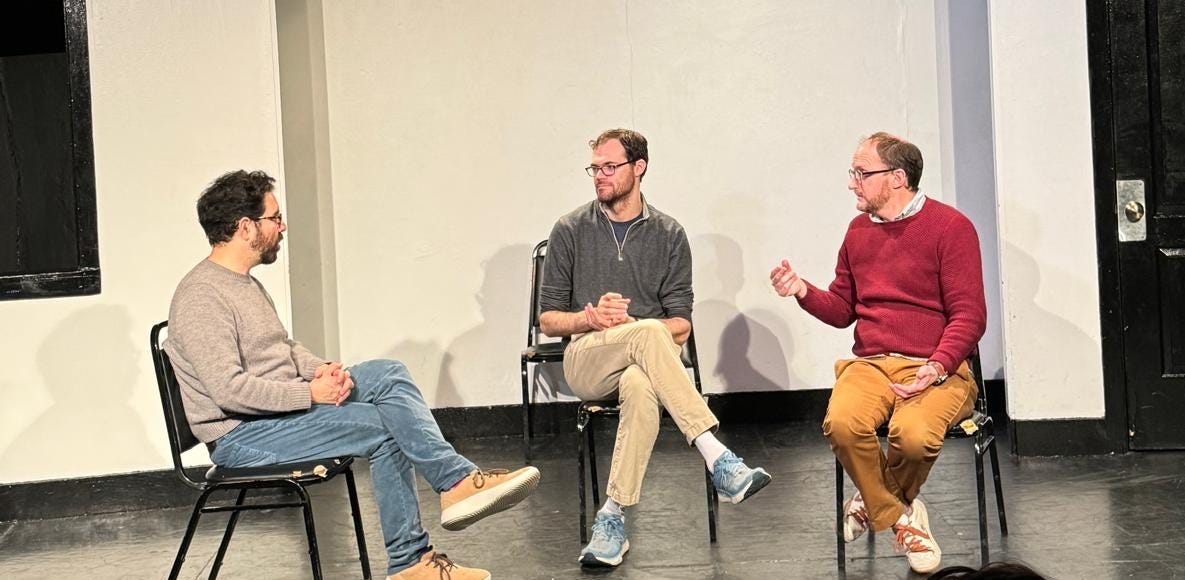
At the weekend I did a show where I didn’t get up from a chair for the entire 50 minutes of the show. On Sunday night I guested with Louis Kornfeld and Rick Andrews at The Magnet Theater in New York. Rick and Louis are two of my favourite improvisers and I have the joy of working with them each week on their podcast.
During Sunday’s show, I played someone from the city visiting a married couple who had moved out to the country. We were sitting having a conversation about our lives in a garden, while drinking tea and eating cucumber sandwiches. Louis and I didn’t get up once. Rick’s character made a couple of trips to get things from inside the house, including more tea. It was a sublime show.
Am I arguing that we shouldn’t have any physical or space work on stage? Actually, no. We didn’t move much because the scene didn’t need it. I would argue we didn’t need to move much because we were able to show each character’s motivations and purpose clearly without doing so. In fact, to do so would have broken the reality of the scene.
I think lines of dialogue, movements and anything else we do in a scene need meaning. I love good object and environment work - I also dislike seeing people move for no reason on stage. Being afraid of stillness is often a sign of nerves and can be unsettling to an audience. Just as there is power in purposeful silence, there is also power in purposeful stillness.
What do you think? Is watching three people who are mainly sitting down a turn-off for you, even if the dynamic of the characters is interesting? Should I be making more effort to move around (even with my bad back?). I’m interested in how other improvisers think about this.
Also, if you want to read a good book on object an environment work, my friend Dave Raitt has literally written the book on it. Check it out here
Robin Hood International Improv Festival
Got a killer workshop to share with improvisers from around the world? Applications to teach at this year’s Robin Hood International Improv Festival are now open. Check out the details and make your application and we could be seeing you in Nottingham in September!
Shows and Workshops
I’ve teamed up with improv legend Katy Schutte and improv musician extraordinaire Sam Marshall to teach a Musical Improv Weekender in March - and there are ONLY TWO SPOTS LEFT. Day one is a Skills Camp that will go over some of the foundations of musical improv. Day two delves into specific areas and forms you can use as a musical improviser. You can book for one of the days or for the whole weekender. Interested? Step this way: https://www.tickettailor.com/events/katyschutte/1523636
Have a great week,
Lloydie
When directing Living. Dying. Dead - i was initially worried that the show would always finish in a sedentary manner with the death bed scene.
But... that stillness is not a problem because there is a reason for it. Any other movement becomes heightened.
As a big beckett fan - Endgame and happy days have entirely sedentary characters for full plays.
Thanks very much for sharing my book! I completely agree that moving around the stage needs meaning. However, notice the "small energy" movements in your scene with Louis and Rick: sipping tea, eating sandwiches, looking around at the garden. Similarly, an office conversation might have someone taking notes, and in a restaurant they could be eating.
This stuff gives life to the characters without necessarily adding meaning. Though you can make it meaningful - for example, the way you might sip tea in an awkward conversational silence. That non-verbal contribution can be huge, and often very funny.
Absolutely, not every scene needs this, and doing it constantly can become as distracting as being completely still. Movement, large or small, is a tool to be applied consciously.